Virtual Pilgrimage

Week Three: Excursions from Galilee

We’ve been in Capernaum and Mount Beatitudes – now we’re going ‘to the other side’!

Monday 1st March Ah it’s hard to leave Galilee! Before we go too far, let’s do a day trip on a boat like the one Jesus and his disciples took across the Lake.

Lake Galilee is also called ‘Kinneret’ meaning harp, because it’s shaped like one. Today, like Jesus does in Mark 4: 35, we’re going over to ‘the other side’, which I think Jesus meant to sound rather ominous!

Just like in Northern Ireland ‘the other side’ usually means Catholics/Protestants depending on our own identity, to Jesus’ disciples it meant outside firmly Jewish territory, where there were lots of Gentiles.

Sadly, it’s still a divided land. Travelling here involves crossing lots of checkpoints and ‘peace walls’. Some of our main sights are actually not in ‘Israel’ but areas under the Palestinian Authority. (And remember, many of the Arab Palestinians here are Christians.)

Anyway, here’s our boat:

The boat Jesus took would have been similar, apart perhaps from the roof cover, about 8m long and 2.5m wide. It was evening time, getting dark, which adds to the mood of foreboding (Mark 4:35). Mark says the disciples took Jesus ‘in the boat, just as he was’. An intriguing phrase! It seems Jesus was already in the boat asleep when they put out from shore.

Then again, maybe the disciples are still learning to take Jesus ‘as he is’ and not the carefully polished, rose-tinted, managed Jesus they’d like him to be? On trips like this, Jesus can surprise us!

Storms are frequent and sudden on Lake Galilee, like the one that terrifies the disciples. That’s a natural fear. It taps into Jewish thinking about water as dangerous, needing deliverance. The watery chaos at creation, for example, or the flood or Red Sea.

But the greater fear is after Jesus stills the storm. Only God can control the weather, bring calm to swirling waves … in the end, it’s not the storm they are afraid of, it’s God, there with them in the boat!

I think it’s more than a healthy ‘fear of God’, because of the way Jesus responds: ‘Why are you afraid? How is it that you still have no faith?’ (v. 40).

Have you ever considered that we might actually be more afraid of God at work than the situation we’re in? What if God really does answer our prayers … make his will clear, bring all those other people into church to sit in pews around us, reconcile us with someone we’ve fallen out with …

God at work can be scary! Because it’s often something new, something we can’t understand.

There’s plenty of time to mull these things over on a pilgrimage, on the way from place to place.

A calmer evening by Lake Galilee aka Kinnereth/Tiberias

Here’s the full story:

Late that day he said to them, “Let’s go across to the other side.” They took him in the boat as he was. Other boats came along. A huge storm came up. Waves poured into the boat, threatening to sink it. And Jesus was in the stern, head on a pillow, sleeping! They roused him, saying, “Teacher, is it nothing to you that we’re going down?” Awake now, he told the wind to pipe down and said to the sea, “Quiet! Settle down!” The wind ran out of breath; the sea became smooth as glass. Jesus reprimanded the disciples: “Why are you such cowards? Don’t you have any faith at all?” They were in absolute awe, staggered. “Who is this, anyway?” they asked. “Wind and sea at his beck and call!”

Mark 4: 35-41 (The Message)

Tuesday 2nd March After a lovely calm crossing, it’s time to get off and explore a new place – Kursi. (No I hadn’t heard of it either!)

Arrival by boat into Kursi, on the ‘other side’

We’re very close to the Lebanese border today, in the Golan Heights, and in tense times this site is out of bounds. It was pretty off-limits to people in Jesus’ earthly lifetime too – a military outpost of the Roman army.

Look at the photos below: tombs cut into rock, and a big sloping foothill. Kursi is the modern name of the place where we believe a troubling encounter took place, the exorcism of a man plagued by a ‘Legion’ of demons.

When Jesus called this the ‘other side’, he really meant ‘other’! Pigs will feature in the story, and remember they’re not kosher, so this is not a nice Jewish neighbourhood.

‘Immediately’ upon arrival, Jesus and his disciples hear the possessed man, so here’s the story without further ado:

When Jesus got out of the boat, a man with an impure spirit came from the tombs to meet him. This man lived in the tombs, and no one could bind him anymore, not even with a chain. For he had often been chained hand and foot, but he tore the chains apart and broke the irons on his feet. No one was strong enough to subdue him. Night and day among the tombs and in the hills he would cry out and cut himself with stones.

(Have you noticed, by the way, that the word ‘tombs’ has come up three times? It’s like this place is an encounter with the forces of death itself!)

When he saw Jesus from a distance, he ran and fell on his knees in front of him. He shouted at the top of his voice, “What do you want with me, Jesus, Son of the Most High God? In God’s name don’t torture me!” For Jesus had said to him, “Come out of this man, you impure spirit!”

Then Jesus asked him, “What is your name?”

“My name is Legion,” he replied, “for we are many.” 10 And he begged Jesus again and again not to send them out of the area.

11 A large herd of pigs was feeding on the nearby hillside. 12 The demons begged Jesus, “Send us among the pigs; allow us to go into them.” 13 He gave them permission, and the impure spirits came out and went into the pigs. The herd, about two thousand in number, rushed down the steep bank into the lake and were drowned.

14 Those tending the pigs ran off and reported this in the town and countryside, and the people went out to see what had happened. 15 When they came to Jesus, they saw the man who had been possessed by the legion of demons, sitting there, dressed and in his right mind; and they were afraid. 16 Those who had seen it told the people what had happened to the demon-possessed man—and told about the pigs as well. 17 Then the people began to plead with Jesus to leave their region.

Mark 5: 2-17 (NIV)

Now the disciples just thought the storm they’d just experienced was scary! But just the same way the wind and waves obey Jesus, so do demons. When Jesus comes on the scene, the man falls down. Is this worship and recognition, or a cry for deliverance?

When we say today that people have their ‘demons, to face their demons or battle with them, we are using the word metaphorically, I think. Destructive things that have power over us. That attach themselves to us and degrade our humanity. Say an alcoholic’s struggle with drink. Or the psychological scars within us, the fears, regrets and shame that we carry around and that sabotage our efforts to live a blessed life.

These demons are often the loudest when we’re silent, and people who go on retreat often find it a tough experience. Spiritual directors try to pinpoint these blockages and wounds and defence mechanisms and name them.

Like Jesus asked the demon in Kursi to name himself.

Legion. Maybe this is a group name for the many demons afflicting him inside and out. Maybe it means there are too many to name. Maybe it has to do with the Roman ‘legion’ stationed nearby. Ethnic conflict, military occupation and oppression, glorification of violence, rule by might, these things all have a whiff of the Enemy about them.

Jesus exorcises the demons, and they go into a herd of pigs instead. These swine run headlong down the slope we see up there, into the lake, and are drowned.

Once again, the response is fear. The people of the village are probably angry about their herds – their livelihoods. They beg Jesus to leave the region.

Aren’t we strange beings? A violent, supernaturally strong, uncontrollable man gets his life and dignity back – and the response is fear! Scared of demons, but more scared to face them, and more scared still to know that God is at work in this world of ours, driving out evil forces.

Wednesday 3rd March Join us this evening at 7.30 for a short Lent service. Then come back on Thursday for our last few days before we head south towards Jerusalem.

Virtual Pilgrimage

End of Week Two

Thursday 25th February Last night in our Lent Service we reflected briefly on the Beatitudes (Matthew 5). The traditional site for the Sermon on the Mount is this place:

It’s called Mount Beatitudes and it’s no distance at all from Capernaum. There’s a good flat slope up on top, perfect for assembling a crowd – a natural amphitheatre. Luke calls it the ‘Sermon on the Plain’, and some people are keen to point out that we can reconcile the two when we look at the flat area on this mount. More likely, I think, Jesus preached the same sermon several times in several locations, tweaking it each time for the particular audience. And that’s why in our Bibles the words vary a bit between the four Gospel-writers.

More interesting for me is the ‘negative altitude’. From the summit, looking down at Capernaum, we feel high up. We are 200m above the water level of the Lake. But what we don’t realise is that we’re 25m below sea level!

I think that’s a fun fact considering Jesus is preaching about the reversal of fortunes, and how the meek and lowly will be exalted, and the proud and haughty brought low. Sometimes we might have to re-think our station in God’s upside-down (or should that be right-ways-up) Kingdom.

The Franciscan church atop the mount has landscaped and maintained a beautiful garden for pilgrims to stop and enjoy. Let’s pause for a moment and ponder those words of Jesus:

When Jesus[a] saw the crowds, he went up the mountain; and after he sat down, his disciples came to him. Then he began to speak, and taught them, saying:

“Blessed are the poor in spirit, for theirs is the kingdom of heaven.

“Blessed are those who mourn, for they will be comforted.

“Blessed are the meek, for they will inherit the earth.

“Blessed are those who hunger and thirst for righteousness, for they will be filled.

“Blessed are the merciful, for they will receive mercy.

“Blessed are the pure in heart, for they will see God.

“Blessed are the peacemakers, for they will be called children of God.

10 “Blessed are those who are persecuted for righteousness’ sake, for theirs is the kingdom of heaven.

11 “Blessed are you when people revile you and persecute you and utter all kinds of evil against you falsely[b] on my account. 12 Rejoice and be glad, for your reward is great in heaven, for in the same way they persecuted the prophets who were before you.

Matthew 5

Friday 26th February You might not have heard of Tabgha, the ‘Seven Springs’. We can set out the boat if you like, it’s just a short hop from Capernaum along the northern part of the Lake. After all, you can’t come to Galilee and not get out on the water.

Tabgha seen from Lake Galilee

Tabgha is associated with two events in Jesus’ life. The first is the miracle of the multiplication of loaves and fish. There’s a good space here for 5000+ diners, but it’s too remote to nip into the neighbouring villages to buy food. Fortunately, Jesus had it under control!

This mosaic at the Church of the Multiplication is iconic, and you can buy your own souvenir here if you like: a key-chain, postcard, dinner plate, framed print, apron … just remember to haggle!

Mosaic at the Church of the Multiplication

The second event is Jesus’ fourth resurrection appearance. Peter and his companions had returned to their old lives fishing in Galilee after Jesus’ resurrection. And then this happened:

After these things Jesus showed himself again to the disciples by the Sea of Tiberias; and he showed himself in this way. Gathered there together were Simon Peter, Thomas called the Twin,[a] Nathanael of Cana in Galilee, the sons of Zebedee, and two others of his disciples. Simon Peter said to them, “I am going fishing.” They said to him, “We will go with you.” They went out and got into the boat, but that night they caught nothing.

Just after daybreak, Jesus stood on the beach; but the disciples did not know that it was Jesus. Jesus said to them, “Children, you have no fish, have you?” They answered him, “No.” He said to them, “Cast the net to the right side of the boat, and you will find some.” So they cast it, and now they were not able to haul it in because there were so many fish. That disciple whom Jesus loved said to Peter, “It is the Lord!” When Simon Peter heard that it was the Lord, he put on some clothes, for he was naked, and jumped into the sea. But the other disciples came in the boat, dragging the net full of fish, for they were not far from the land, only about a hundred yards[b] off.

When they had gone ashore, they saw a charcoal fire there, with fish on it, and bread. 10 Jesus said to them, “Bring some of the fish that you have just caught.” 11 So Simon Peter went aboard and hauled the net ashore, full of large fish, a hundred fifty-three of them; and though there were so many, the net was not torn. 12 Jesus said to them, “Come and have breakfast.” Now none of the disciples dared to ask him, “Who are you?” because they knew it was the Lord. 13 Jesus came and took the bread and gave it to them, and did the same with the fish.

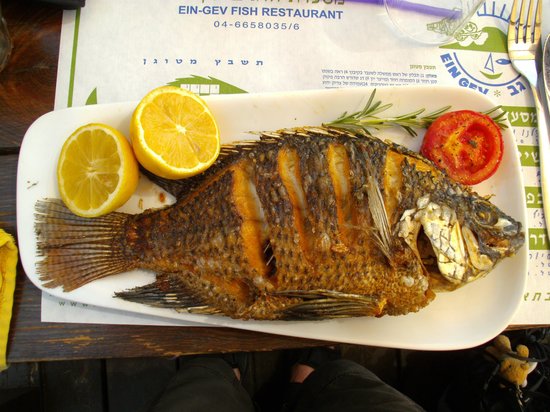
If you’re feeling hungry, there are several restaurants serving up delicious ‘St Peter’s fish’, which I think is tilapia, fried with salad and chips.

Peter features in the next verses of John 21 also. Many Christians have detected in Jesus’ command to ‘feed my sheep’ and a prediction that he too would be executed. The other local church here in Tabgha is dedicated to St Peter for this reason.

A very special experience for pilgrims here is to celebrate Holy Communion, either in one of these churches or down on the shore itself. Maybe if we start saving our pennies we could do it for real, after Covid is under control and we can get travelling again?

Sunday 28th February Join us at 10am for morning worship live from Christ Church, Castlerock @CastlerockDunboe

Next week beginning Monday 1st March, we’ll venture a little further from the Lake on a few day trips. Before we know it, it’ll be time to set our faces towards Jerusalem.

Galilee in the evening

Virtual Pilgrimage

Week Two: Galilee

Monday 22nd February Our first stopover on the way to the Lake of Galilee is Nazareth. Today, it’s the ‘Arab capital of Israel’ with a mixed population of Palestinian Christians and Muslims.

Nazareth viewed from Mount Precipice

Can you see the big basilica (church) dominating the city? That’s the Church of the Annunciation. In Jesus’ time, the whole of Nazareth was not much bigger than the floor plan of this church! A far cry from the bustling city it is today.

You might remember how people viewed Nazareth. Nathaniel asks ‘can anything good come from Nazareth?’ (John 1: 46). Any time Jesus is referred to as a Nazarene, it’s probably said with a bit of a sneer.

Mount Precipice, outside Nazareth

To get this lovely panoramic view, the best vantage point is Mount Precipice (above). Jesus launched his ministry in Nazareth, at the synagogue. For years, there was no evidence of a synagogue in Nazareth and it was such a small backwater it seemed unlikely it would have had more than an outdoor gathering place for Sabbath worship. But recently a small synagogue has been discovered, quite possibly where Jesus read his ‘manifesto’ from Isaiah:

‘The Spirit of the Lord is on me,
    because he has anointed me
    to proclaim good news to the poor.
He has sent me to proclaim freedom for the prisoners.’
    and recovery of sight for the blind,
to set the oppressed free,
19     to proclaim the year of the Lord’s favour.

Luke 4: 18-20, quoted from Isaiah 61: 1-2

For the people in Jesus’ hometown, he’s just the carpenter’s son. They know him; he knows them. How dare he talk like this? They drag him up Mount Precipice here, overlooking the city, with the intention of throwing him off.

They don’t succeed, of course, and later this week we’ll visit Capernaum where Jesus made his home after this incident.

But of course for most of us Nazareth is associated with Jesus’ infancy, more so than his adult ministry. This is where Mary and Joseph lived, where a miracle took place, and where the boy Jesus grew up.

The Basilica of the Annunciation, built on the site of Mary’s home in Nazareth

According to tradition, this basilica is built over Mary’s home where the angel Gabriel appeared to her with the amazing news that she would bear God’s Son. (Tradition is probably right, bearing in mind the size of the church and the size of Nazareth back then!)

The Grotto of the Annunciation
Close-up of the altar: Verbum caro hic factum est – The Word was made flesh here

This definitely is one holy place where I get the feeling, it matters that this is not just an idea but a historical reality in time and space: the Word was made flesh – and God entered our world here, in this place!

And this is where Mary the Mother of our Lord accepted God’s call: May it be to me according to your will.

Tuesday 23rd February A new day, a new location. Today, we’re on the shore of the Sea (ie Lake) of Galilee, in a village called Capernaum.

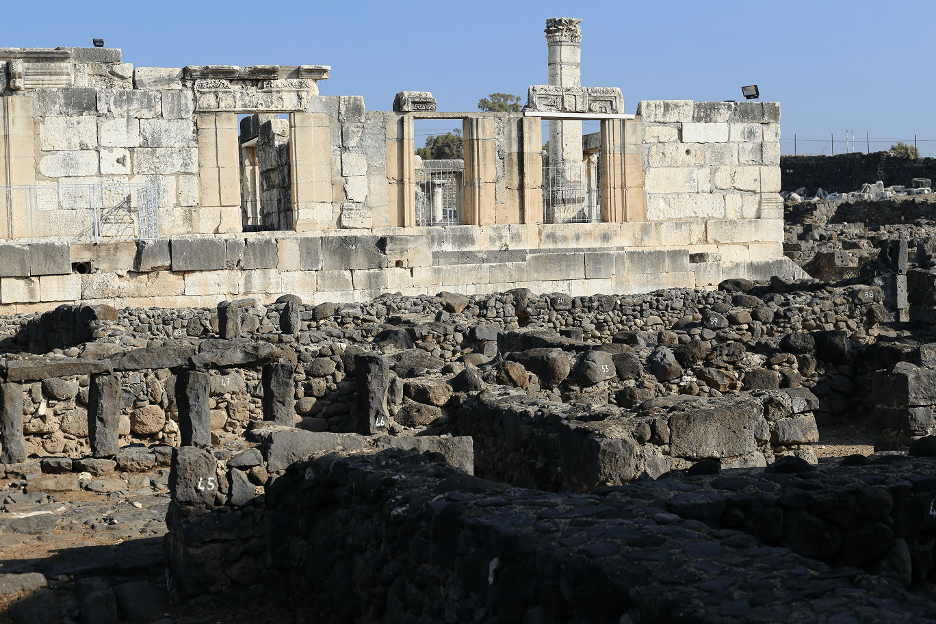
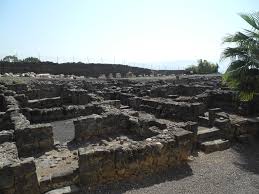
Jesus used this place as a mission base after he was chased out of his hometown Nazareth. Look at these black stones. They are remnants of the same houses that Jesus walked past, entered … and one like this had its roof taken off to lower a paralysed man down in front of Jesus!

Can you see how small the houses are? These were occupied by fishers, farmers, tax collectors and Romans, all living cheek by jowl. Each family had an ‘isola’, basically a room with maybe a cupboard added on. In ancient life, there was nothing like our concept of privacy! When the Bible says that Jesus came and lived among us …

One very famous resident in Capernaum was Peter. We can be fairly certain about the location of his house because there’s graffiti on the wall. It seems very, very early Christians wanted to make sure we knew who lived here – and they weren’t too concerned about carving into the rock!

The modern church built over St Peter’s house is meant to resemble a boat on the Lake. Personally, I think it looks more like a spaceship! This is where Peter’s mother-in-law was healed from a fever.

The ‘White Synagogue’ in Capernaum

As you wander around Capernaum, there is a real sense that Jesus stood here. Nowhere is this more so than the synagogue. The ‘White Synagogue’ is later, but the black foundations are the very stones where Jesus stood in 1st C Palestine.

They went to Capernaum, and when the Sabbath came, Jesus went into the synagogue and began to teach. 22 The people were amazed at his teaching, because he taught them as one who had authority, not as the teachers of the law.

Mark 1: 21-22

After worship in the synagogue, Jesus and his disciples would walk the short distance to Peter’s house, or more often down to the shore or along the lake to a neighbouring village.

So, more exploring in Jesus’ footsteps in the coming days!

Wednesday 24th February Join us tonight for a short Lenten prayer service at 7.30 pm @CastlerockDunboe on Facebook.

Virtual Pilgrimage

Week 1: Judean Wilderness

Ash Wednesday 2021 Shalom and welcome! We set out today on our ‘virtual pilgrimage’ from the Parish of Castlerock & Dunboe to the Holy Land. We’re starting in the Judean wilderness at Jebel al-Quruntul, better known as the ‘Mount of Temptation’.

Imagine yourself getting off the coach and standing here. It’s a very pleasant 24 degrees today. It gets a lot hotter, of course, and come sundown the temperature will suddenly plummet.

It is eerily silent. This is not a sandy desert like the Sahara, but a rocky landscape of cliffs, crags and channels running between them. When you look up, you can see where over the centuries rainwater has created networks of hundreds and hundreds of caves. One of these caves is reputedly where Jesus spent his 40 days in the desert. It would have protected him from the extremes of temperature and from the punishing sun.

Look down at your feet. There are rocks everywhere. This is where John the Baptist told the Pharisees who came to him to be baptized, ‘Don’t tell me ‘we have Abraham as our father’ – for I tell you, God is able to turn these rocks into children of Abraham!’ (Matt. 3: 9).

Today, we remember how Jesus was in this place to be tempted, and he was hungry. As he stood looking at these rocks by our feet, the devil tempted him to turn them into bread:

Then Jesus was led up [‘up’ as in to a high, rocky place like where we are imagining ourselves to be now] by the Spirit into the wilderness to be tempted by the devil. He fasted forty days and forty nights, and afterwards he was famished. The tempter came and said to him, “If you are the Son of God, command these stones to become loaves of bread.” But he answered, “It is written,

‘One does not live by bread alone,
    but by every word that comes from the mouth of God.’”

Then the devil took him to the holy city and placed him on the pinnacle of the temple, saying to him, “If you are the Son of God, throw yourself down; for it is written,

‘He will command his angels concerning you,’
    and ‘On their hands they will bear you up,
so that you will not dash your foot against a stone.’”

Jesus said to him, “Again it is written, ‘Do not put the Lord your God to the test.’”

Again, the devil took him to a very high mountain [quite possibly the one we’re looking at now] and showed him all the kingdoms of the world and their splendour; and he said to him, “All these I will give you, if you will fall down and worship me.” Jesus said to him, “Away with you, Satan! for it is written,

‘Worship the Lord your God,
    and serve only him.’”

Then the devil left him, and suddenly angels came and ministered to him.

Matthew 4: 1-11

It looks like, as last year, we’ll be living Lent in lockdown conditions. We might well wonder, should I bother this year? Isn’t life tough enough these days? Do I really need to forego chocolate?

Lenten practices are personal and (other than church attendance) optional. I’ll leave that up to you. I do hope that you’ll continue this journey with us, and that it helps renew our devotion to our Lord.

One thought: we think of the wilderness as a harsh, cruel, barren place – and in many ways it is. But when the rain falls to the east, rivers appear from nowhere and run through this wild landscape, making ways through that we never thought possible before; washing away debris; carving out caves where we can take shelter.

Look down again at the many, many rocks by your feet. This is the hostile environment where Jesus was sorely tested. It is also the ground where God’s angels stooped to care for him.

It is in often in the desert that we see God’s grace to us most clearly.

https://www.facebook.com/CastlerockDunboe for our Service of Holy Communion for Ash Wednesday, tonight at 7.30pm from Christ Church, Castlerock

Thursday 18th February Yesterday we were looking at the rocks by our feet. Now look up … what can you see up there on the mountain?

That is a Greek Orthodox monastery, built on the ‘very high mountain’ where the devil tempted Jesus to worship him in exchange for ‘all the kingdoms of the world and their splendour’ (Matt. 4: 8).

You can reach it by cable car. Now, you can’t literally see ‘all the kingdoms of the world’, although there are amazing views. When Jesus ‘saw’ all this, it seems to have been a psychological or supernatural vision (see Luke 4: 5, ‘in an instant’).

Like many sights along our pilgrimage, there’s a question mark over whether this really is the exact spot. In the first centuries, Christians in the Holy Land passed on traditions handed down over generations since the days of the by eyewitnesses. In the 300s AD, St Helen travelled to Jerusalem and recorded a lot of this information. But even if this is not the exact cave Jesus slept in, it would have been one very like it:

Everywhere we’ll see churches and monasteries built on these sites. It can be a challenge, because it is not how we imagined the scene when we learnt these stories in Sunday School. I’m sure the tiled floor, prayer cards and coins weren’t here when Jesus was!

The monks in the Monastery of Temptation follow in the tradition of the Desert Fathers and Mothers. They live a life of extreme simplicity and silence in order to hear God’s voice clearly.

Simplicity and silence are keynotes of Lent. (It’s not really about going out of our way to make ourselves suffer.) These are important because we are often so busy, and life gets so complicated, that God gets squeezed out.

In the first lockdown, we all said how it was good to get back to basics. We baked bread, walked, and enjoyed walks in nature. We noticed how quiet it was. We heard birdsong that we’d not noticed before.

With fewer distractions, many of us found more time to pray and read scripture, and many of you told me how the experience had brought you closer to God.

If we’ve lost some of that simplicity and silence in this second (third? lost count?) lockdown, now is our chance to try again. We don’t have to become monks/nuns and live a cloistered existence – most of us are not called to do that. But we can make a conscious decision to set aside regular time to be still before God in prayer.

My soul, wait in silence for God alone,

For my hope is from Him.

He alone is my rock and my salvation,

My refuge; I will not be shaken.

Psalm 62: 5-6

Friday 19th February A ‘wadi’ is an oasis in the desert where water springs up through the rock, appearing especially in rainy season. Here’s a particularly lovely one for us to visit in the Judean wilderness:

It’s called Wadi David Ein Gedi. This (or somewhere very like it) is where King David hid out, back when King Saul was refusing to vacate the throne and making threats. David wrote some of the most beautiful psalms in the wilderness:

A Psalm of David, written in the wilderness of Judah

63 O God, you are my God; earnestly I seek you;
    my soul thirsts for you;
my flesh faints for you,
    as in a dry and weary land where there is no water.
So I have looked upon you in the sanctuary,
    beholding your power and glory.
Because your steadfast love is better than life,
    my lips will praise you.
So I will bless you as long as I live;
    in your name I will lift up my hands.

My soul will be satisfied as with fat and rich food,
    and my mouth will praise you with joyful lips,
when I remember you upon my bed,
    and meditate on you in the watches of the night;
for you have been my help,
    and in the shadow of your wings I will sing for joy.
My soul clings to you;
    your right hand upholds me.

When you’ve been a little while in the desert around the Mount of Temptation, how wonderful to come across a lush, green spot to cool off in the water! David drank from these wadis. I wouldn’t myself (a lot of people swim here! I once did), so when he writes ‘my soul thirsts for you’ he knows what he’s talking about. Being in the Holy Land (even virtually) really can enhance the way we read and understand the Bible.

Let’s pray that, if we’re spiritually running dry, God will provide for us those refreshing little oases along our journey. And remember to keep drinking, folks – it’s easy to get dehydrated on these pilgrimages – just like during our earthly pilgrimage!

Now, if you’d kindly board the coach, it’s time for the next phase of our pilgrimage. This Sunday 21st February at 10am, we will gather online for worship from Christ Church, Castlerock, and on Monday we head north to Galilee where Jesus grew up and launched his ministry.

https://www.facebook.com/CastlerockDunboe for more goings-on, including weekly services on Sundays at 10am and Wednesdays in Lent at 7.30pm

Introduce Yourself (Example Post)

This is an example post, originally published as part of Blogging University. Enroll in one of our ten programs, and start your blog right.

You’re going to publish a post today. Don’t worry about how your blog looks. Don’t worry if you haven’t given it a name yet, or you’re feeling overwhelmed. Just click the “New Post” button, and tell us why you’re here.

Why do this?

  • Because it gives new readers context. What are you about? Why should they read your blog?
  • Because it will help you focus you own ideas about your blog and what you’d like to do with it.

The post can be short or long, a personal intro to your life or a bloggy mission statement, a manifesto for the future or a simple outline of your the types of things you hope to publish.

To help you get started, here are a few questions:

  • Why are you blogging publicly, rather than keeping a personal journal?
  • What topics do you think you’ll write about?
  • Who would you love to connect with via your blog?
  • If you blog successfully throughout the next year, what would you hope to have accomplished?

You’re not locked into any of this; one of the wonderful things about blogs is how they constantly evolve as we learn, grow, and interact with one another — but it’s good to know where and why you started, and articulating your goals may just give you a few other post ideas.

Can’t think how to get started? Just write the first thing that pops into your head. Anne Lamott, author of a book on writing we love, says that you need to give yourself permission to write a “crappy first draft”. Anne makes a great point — just start writing, and worry about editing it later.

When you’re ready to publish, give your post three to five tags that describe your blog’s focus — writing, photography, fiction, parenting, food, cars, movies, sports, whatever. These tags will help others who care about your topics find you in the Reader. Make sure one of the tags is “zerotohero,” so other new bloggers can find you, too.

Design a site like this with WordPress.com
Get started